
Customer Challenge
Unlocking the full potential of the Pre-salt Toca reservoir’s turbiditic carbonate lenses has proven challenging for our client. Despite highly productive well tests, evidence of compartmentalization, varying pressure regimes, and different oil qualities present technical and commercial obstacles. The complexity deepens with lateral facies variations observed from well to well, without apparent inter-relationships. Seeking a way forward, the client turns to Vulcania Energy to investigate communication between wells and identify prospective areas for future appraisal.
Solution
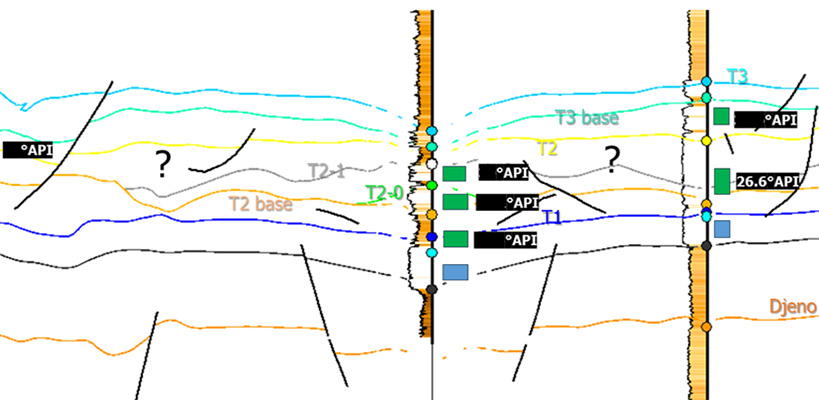
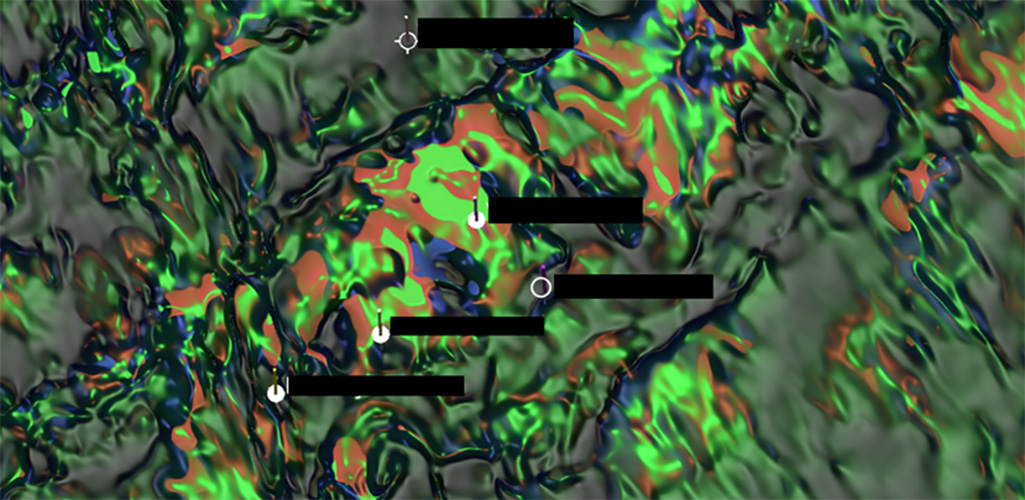
To delve into the interplay between structural and stratigraphic complexities, we executed a meticulous seismic reprocessing initiative. This involved noise suppression, removal of multiples, and refining the current velocity model. A spectral decomposition allowed us to successfully identify the turbiditic slope fan architectural elements of the deposit. Armed with this new understanding, we embarked on a distinct seismic interpretation of the Toca sequences, precisely delineating the intra-reservoir domain using the latest auto-tracking tools. This analysis revealed strong correlation at the top and bottom intra-sequence levels, while suggesting a set of erosive events at the middle level.
Outcome & Value Delivery
The seamless integration of seismic reprocessing, petrophysics, and reservoir engineering yielded transformative results for our client. Our investigations unveiled that two wells were situated near the channel axis, while the others resided on crevasse splays. The new seismic interpretation confirmed the reservoir’s complex compartmentalization, allowing us to refocus the field’s development on promising adjacent areas along the channel axis. We successfully identified a 22 million barrels of oil equivalent (mmstb) candidate for a robust appraisal well.
